



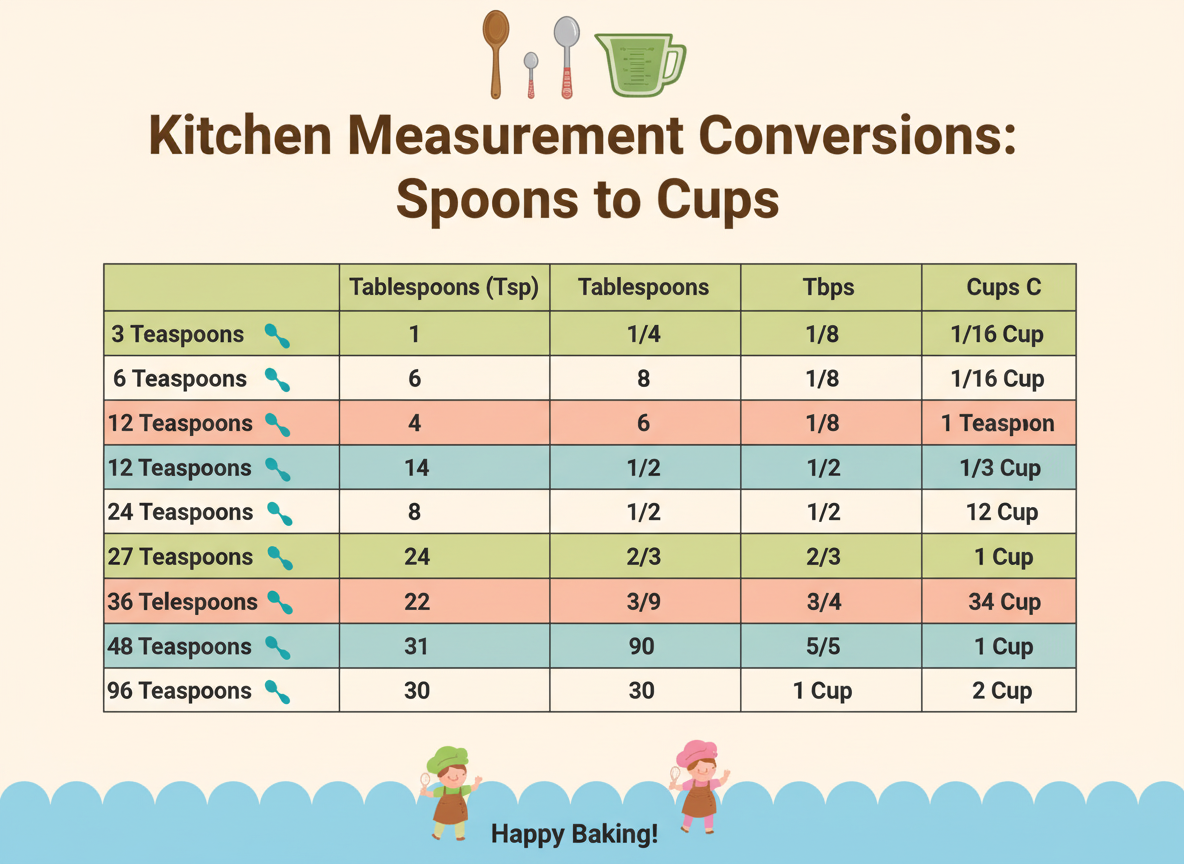
Here’s the relationship that makes everything make sense: 1 cup = 16 tablespoons. That’s the number to burn into your brain. Everything else flows from it.
So if you want to know how many cups 3 tablespoons is, you just divide:
3 ÷ 16 = 0.1875 cups
Full Tablespoons to Cups Conversion Chart
Here’s the chart I genuinely wish I had on my fridge years ago. Every tablespoon amount from 1 to 16, converted to cups — with the fraction form you’d actually use in a recipe.
Notice how the clean, standard fractions — ¼ cup, ½ cup, ¾ cup — all fall on even tablespoon numbers (4, 8, and 12). That’s not a coincidence. Those are the measures your standard set of measuring cups is designed around.
How to Measure 3 Tablespoons Without a Tablespoon
What if you only have measuring cups and no tablespoon? Or you only have teaspoons? No problem. Here’s how to get exactly 3 tablespoons using whatever you have on hand.
Where You’ll See 3 Tablespoons Come Up in Real Recipes
Three tablespoons is a surprisingly common amount in everyday cooking and baking. Once you know what it looks like, you’ll start spotting it everywhere.
- Salad dressings — Most homemade vinaigrette recipes use 3 tablespoons of oil or vinegar as a base for a single serving. It’s almost exactly the amount that fits in a small ramekin.
- Butter in baking — Many muffin and quick bread recipes call for 3 tablespoons of melted butter. It adds richness without making the batter too heavy.
- Sauces and marinades — Teriyaki, honey garlic, and soy-based sauces often use 3 tablespoons of a key ingredient as the flavor base.
- Spice rubs — A 3-tablespoon spice rub is roughly enough to coat a medium-sized piece of chicken or a small rack of ribs.
- Cream cheese frosting — Classic cream cheese frostings often start with 3 tablespoons of butter blended with cream cheese before the powdered sugar goes in.
- Cocktail and coffee drinks — 3 tablespoons is about 45ml — which is exactly a double shot of espresso or a standard double pour of spirits.
Common Measuring Mistakes That Ruin Recipes
I’ve made most of these. So has every home cook who’s ever had a cake come out wrong and couldn’t figure out why. Here are the measuring errors that sneak into recipes without you noticing.
Scooping Flour Directly From the Bag
This is probably the single most common baking mistake. When you scoop a measuring cup directly into a flour bag, you compact the flour — meaning you’re getting significantly more than the recipe intended. The right way is to spoon the flour into the measuring cup and level it off. With tablespoons, the same rule applies: don’t pack dry ingredients unless the recipe specifically says to.
Not Levelling Off
A heaped tablespoon is not the same as a level tablespoon. For baking especially, this matters. Use the back of a knife or a straight spatula to scrape across the top of the spoon so the ingredient is flat with the edges.
Using the Wrong Spoon
A regular dinner spoon from your cutlery drawer is not a tablespoon. It’s close, but not close enough for baking. A standard US tablespoon holds exactly 15ml. A random kitchen spoon might hold 10ml or 20ml depending on the style. Always use a proper measuring spoon when accuracy matters.
 Liquid vs Dry Measurements
For liquids, a tablespoon is a tablespoon — 15ml, simple. But for dry ingredients like flour, sugar, or cocoa powder, the weight per tablespoon varies a lot. 1 tablespoon of flour weighs about 8g. 1 tablespoon of sugar weighs about 12g. 1 tablespoon of salt weighs about 18g. If your recipe uses weight (grams or ounces), always weigh rather than measure by volume for the most accurate result.
Measuring Sticky Ingredients Without a Spray
Honey, maple syrup, peanut butter — they all cling to tablespoons and cups, meaning you lose some of the ingredient every time. A quick fix: lightly spray your measuring spoon with cooking spray before filling it with anything sticky. It slides right out and you get an accurate measure every time.
Tablespoons to Other Units — Quick Reference
Sometimes you need to go beyond just tablespoons and cups. Here’s how 3 tablespoons converts into every other common unit you might encounter in a recipe:
Final Thoughts
Okay so hopefully your recipe is back on track. And maybe now — just maybe — you actually know why 3 tablespoons is 3/16 of a cup instead of just copy-pasting the number and moving on. The one thing worth holding onto is this: 1 cup = 16 tablespoons. That’s the whole system. Everything else is just dividing.
Next time a recipe throws a weird fraction at you, you won’t even need to Google it. You’ll just count tablespoons, do the quick divide, and keep going without missing a beat. That’s the kind of kitchen knowledge that doesn’t sound impressive but saves you genuinely every single time you cook.
Now go finish whatever you were making. And if it turns out great, you’re welcome. If it doesn’t — that’s on the recipe, not the measuring. 
3 Tablespoons to CupsTablespoon ConversionKitchen MeasurementsCooking ConversionsBaking TipsCups to TablespoonsRecipe HelpMeasuring Guide
