



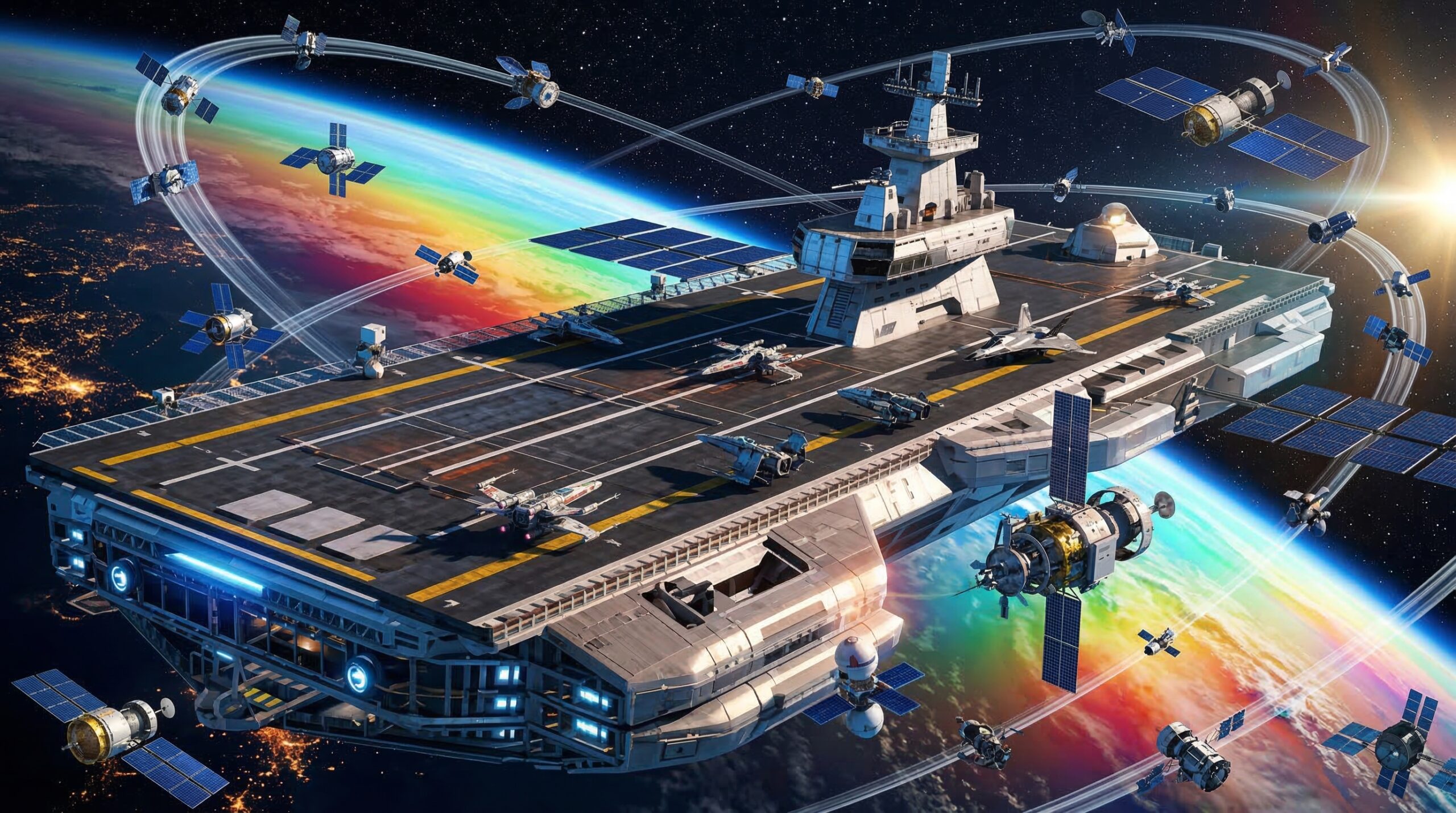
Space has always been the ultimate strategic high ground. Whoever controls the skies controls the battlefield—that’s been true since the first reconnaissance planes flew over enemy lines. Now, that principle is being applied on a far grander scale.
The concept of a space force orbital warship carrier sounds like something ripped from the pages of a science fiction novel. But as nations pour billions into space defense programs, and as the United States Space Force (USSF) matures into a fully operational military branch, the idea is attracting serious attention from defense analysts, aerospace engineers, and military strategists alike.
This isn’t purely theoretical. Space is already militarized. Satellites guide missiles, enable surveillance, and underpin the communications infrastructure of every modern military. The question is no longer whether space will play a role in future warfare—it already does. The real question is how far that militarization will go, and whether orbital warship carriers represent the next logical step.
In this post, we break down what a space force orbital warship carrier would actually be, what technologies it would require, and the significant legal and geopolitical hurdles standing in its way.
What Is a Space Warship Carrier?
Before diving into feasibility, it helps to define the concept clearly.
A space warship carrier is a large, crewed or semi-autonomous spacecraft designed to serve as a mobile military platform in orbit. Think of it as the space equivalent of a naval aircraft carrier—a command-and-control hub capable of deploying smaller spacecraft, offensive or defensive weapon systems, and surveillance assets from orbit.
Unlike a satellite, which passively collects data or relays communications, an orbital warship carrier would be an active military platform. It would be capable of:
- Launching and recovering smaller drone spacecraft or interceptors
- Projecting power across vast orbital distances
- Conducting electronic warfare operations
- Serving as a resupply and command hub for other space-based assets
Some defense thinkers compare it to the shift from battleships to aircraft carriers in World War II—a fundamental change in how military power is projected, only this time the theater of operations is hundreds of miles above Earth’s surface.
The Role of the United States Space Force
Established in December 2019, the United States Space Force is the world’s first independent space military branch. Its mission centers on protecting U.S. interests in space, deterring aggression, and conducting space operations.
The USSF currently focuses on:
- Satellite protection: Defending GPS, communications, and early-warning satellites from adversary interference
- Space situational awareness: Tracking thousands of objects in orbit
- Offensive space capabilities: Developing systems that could disrupt or disable enemy satellites
The concept of a space force orbital warship carrier fits naturally into the USSF’s long-term strategic vision. As rival nations—particularly China and Russia—develop anti-satellite weapons and their own military space programs, the United States faces growing pressure to maintain orbital superiority.
China’s People’s Liberation Army Strategic Support Force and Russia’s Aerospace Forces are both investing heavily in space capabilities. That competition is quietly reshaping how military planners think about future conflict, and orbital platforms are increasingly part of the conversation.
Potential Features and Capabilities
A functional space force orbital warship carrier would need to be a highly sophisticated, multi-role platform. Defense analysts and aerospace engineers have speculated about several potential features:
Weapons Systems
- Directed-energy weapons: High-powered lasers capable of disabling or destroying enemy satellites and spacecraft
- Kinetic interceptors: Projectiles or missiles launched from orbit to intercept threats
- Electronic warfare systems: Equipment designed to jam or spoof enemy communications and navigation
Command and Control Infrastructure
- Hardened communications arrays resistant to jamming
- AI-assisted targeting and threat assessment systems
- Real-time data links to ground-based military command centers
Deployment Capabilities
- Hangar bays for smaller autonomous spacecraft or drones
- Rapid-launch systems for deploying interceptors or recon assets
- Modular payload bays to swap out mission-specific equipment
Crew and Life Support
- Long-duration life support for a rotating crew
- Radiation shielding for extended time in the harsh space environment
- Autonomous operations capability during periods without crew
The scale of such a platform would likely dwarf the International Space Station, requiring a mass of potentially thousands of tons—far beyond anything currently launched into orbit.
Technologies Required to Build Orbital Military Platforms
Here’s where things get complicated. Building a space force orbital warship carrier isn’t just a matter of funding—it requires technological leaps across multiple fields simultaneously.
Advanced Propulsion
Current chemical rockets are far too inefficient for a spacecraft that needs to maneuver tactically in orbit. More viable options include:
- Nuclear thermal propulsion: Offers significantly higher thrust-to-weight ratios than chemical engines
- Ion drives: Highly efficient for sustained acceleration but too slow for rapid tactical maneuvers
- Nuclear pulse propulsion: Theoretically powerful but practically and politically problematic
In-Space Manufacturing and Assembly
A warship carrier couldn’t realistically be launched whole from Earth’s surface. It would need to be assembled in orbit, requiring:
- Autonomous robotic assembly systems
- On-orbit fuel depots and resupply infrastructure
- Advanced docking and modular construction techniques
NASA and private companies like SpaceX and Orbital Reef are already developing in-space assembly concepts, laying early groundwork for structures of this scale.
Power Generation
The energy demands of directed-energy weapons alone would be staggering. Nuclear reactors—specifically space-rated fission reactors—are considered the most practical solution for providing the sustained, high-output power such a platform would need.
NASA’s Kilopower project has demonstrated small fission reactors suitable for space applications, but scaling that technology to weapons-grade power output remains a significant challenge.
Materials Science
Operating in the orbital environment means constant exposure to:
- Extreme temperature swings (from +250°F in sunlight to -250°F in shadow)
- High-energy particle radiation
- Micrometeorite impacts
- Atomic oxygen erosion in low Earth orbit
New composite materials and advanced shielding solutions would be essential for long-term structural integrity.
Challenges, Legal Concerns, and International Space Treaties
Even if the technology existed today, a space force orbital warship carrier would face enormous legal and diplomatic obstacles.
The Outer Space Treaty of 1967
The cornerstone of international space law, the Outer Space Treaty, prohibits:
- Placing weapons of mass destruction in orbit or on celestial bodies
- Establishing military bases on the Moon or other celestial bodies
- Using space for military purposes in ways that threaten international peace
Critically, the treaty does not explicitly ban conventional weapons in space. This legal grey area is already being exploited by nations developing anti-satellite weapons. A warship carrier armed with kinetic or directed-energy weapons could theoretically fall within the bounds of the treaty—though it would almost certainly trigger an international political crisis.
The Risk of an Arms Race
Deploying an orbital warship carrier would almost certainly provoke rival nations to develop their own platforms or asymmetric countermeasures. Space debris from orbital weapons tests—as demonstrated by Russia’s 2021 anti-satellite missile test—poses real risks to all spacecraft, including civilian infrastructure.
A weaponized orbital environment isn’t just a military problem. It threatens the satellites that power GPS navigation, weather forecasting, financial transactions, and internet connectivity for billions of people.
Cost and Political Will
The financial investment required to design, build, and maintain a space force orbital warship carrier would be astronomical—potentially in the hundreds of billions of dollars. That scale of expenditure would require sustained political consensus across multiple administrations, a historically difficult feat.
Future Possibilities for Space-Based Defense Systems
Despite the challenges, the trajectory of space defense investment points toward increasingly capable orbital platforms.
Several near-term developments are worth watching:
- The X-37B: The U.S. Air Force’s autonomous spaceplane has conducted multiple long-duration classified missions in orbit, offering a glimpse of what purpose-built military spacecraft might eventually look like
- Reusable launch vehicles: SpaceX’s Starship dramatically reduces the cost of getting mass into orbit, making large-scale orbital construction more economically plausible
- Cislunar security: Both the U.S. and China are eyeing the space between Earth and the Moon as strategically significant, with proposals for monitoring and patrol missions in cislunar space
The USSF has explicitly identified “space domain awareness” and the ability to defend orbital assets as core priorities. A space force orbital warship carrier represents the far end of that spectrum—but the building blocks are being assembled, piece by piece.
Frequently Asked Questions
Does the U.S. Space Force currently have offensive weapons in space?
The USSF does not publicly confirm the existence of offensive space weapons. It does acknowledge developing capabilities to “deny, degrade, and disrupt” adversary space assets, though the specifics remain classified.
Would a space warship carrier violate the Outer Space Treaty?
It depends on armament. The 1967 treaty bans weapons of mass destruction in orbit but does not explicitly prohibit conventional weapons platforms. A carrier armed with kinetic or directed-energy weapons would occupy a legal grey area, though it would likely trigger diplomatic consequences.
How far away is this technology realistically?
Most defense analysts suggest that a true orbital warship carrier remains decades away, if it happens at all. Key bottlenecks include propulsion, power generation, and in-orbit assembly—all of which require major technological breakthroughs.
What is China’s current space military capability?
China’s PLA Strategic Support Force oversees military space operations, including anti-satellite weapons, surveillance satellites, and navigation systems. China has conducted anti-satellite missile tests and is developing reusable spacecraft with potential dual-use military applications.
The Final Frontier of Military Power
Space warfare isn’t coming—it’s already here, in the quiet form of satellite jamming, cyber intrusions, and shadowing maneuvers in orbit. The concept of a space force orbital warship carrier is simply the most dramatic expression of a militarization process that has been underway for decades.
Whether such a platform ever gets built depends on technology, geopolitics, and political will in roughly equal measure. But the groundwork—in the form of the USSF, advanced propulsion research, reusable launch vehicles, and international space power competition—is actively being laid.
The stars have always been a place humanity has looked to with wonder. Increasingly, they’re also a place military strategists look to with strategic intent.
